Plan your visit to the Museu da Misericórdia do Porto
Museu da Misericórdia do Porto is a compact museum-and-church visit best known for its Renaissance art, benefactors’ gallery, and the richly decorated Misericórdia Church hidden behind a plain street facade. The route is easy physically, but the experience is more rewarding if you understand that it is about Porto’s charitable institution rather than general city history. The one thing that most improves the visit is leaving enough time for the church at the end. This guide covers timing, tickets, layout, and what to prioritize.
Quick overview: Museu da Misericórdia do Porto at a glance
This is one of Porto’s quieter cultural stops, which makes it easy to fit into a half-day in the historic center if you know what you’re here for.
- When to visit: Tuesday–Sunday, 10am–5:30pm from November to March and 10am–6:30pm from April to October. Winter weekday mornings are noticeably calmer than Saturday afternoons, because this is when local groups and rainy-day visitors are least likely to overlap.
- Getting in: From €10 for standard entry. The Headout ticket covers museum and church access. Advance booking is mostly about convenience rather than necessity, though weekends in summer can be a little busier.
- How long to allow: 1–1.5 hours for most visitors. It stretches closer to 2 hours if you read the displays closely or spend real time in the church and sacristy.
- What most people miss: The Fons Vitae painting deserves more time than a quick glance, and many visitors stop in the church nave without stepping into the sacristy.
- Is a guide worth it? Yes if you want the benefactors’ portraits and institutional history to make sense; if you mainly want the art and church interior, a self-guided visit is usually enough.
Jump to what you need
Where and when to go
How much time do you need?
| Visit type | Route | Duration | Walking distance | What you get |
|---|---|---|---|---|
Highlights only | Top floor benefactors’ gallery → Fons Vitae → church | 45–60 min | Short indoor route | Covers the headline stops quickly, but you will move fast through the galleries and risk rushing the church. |
Balanced visit | 3rd floor → 2nd-floor sacred art galleries → Fons Vitae → church and sacristy | 1–1.5 hrs | Short indoor route | Gives you enough time for the full route without dragging, including a proper stop at Fons Vitae and the church. |
Full exploration | All 3 exhibition floors → Fons Vitae → church → sacristy with time for labels and audio guide | Nearly 2 hrs | Short indoor route across all floors | Best if you want to read displays closely, use the audio guide, and spend real time in the sacristy at the end. |
Which Museu da Misericórdia do Porto ticket is best for you
| Ticket type | What's included | Best for | Price range |
|---|---|---|---|
Tickets to Misericórdia Museum and Church in Porto | Entry to Misericórdia Museum and Church | A short, flexible visit where you want full access to the museum route and church without committing to a guided schedule | From €10 |
How do you get around Museu da Misericórdia do Porto?
The layout is compact and vertical rather than sprawling, so it is easy to navigate once you understand that the visit works best from top to bottom. In practice, that means using the elevator or stairs to start upstairs, then descending floor by floor until the route ends in the church.
Where are the masterpieces inside Museu da Misericórdia do Porto?

Misericórdia Church
Attribute — Era: 16th-century church with later Baroque interior
The church is the emotional payoff of the visit and the reason many people feel the ticket was worth it. From the street, the facade gives little away, but inside you get gilded woodwork, blue-and-white azulejos, and a much grander space than most visitors expect. What people often rush past is how quiet it feels compared with Rua das Flores outside.
Where to find it: At the end of the museum route on the ground floor
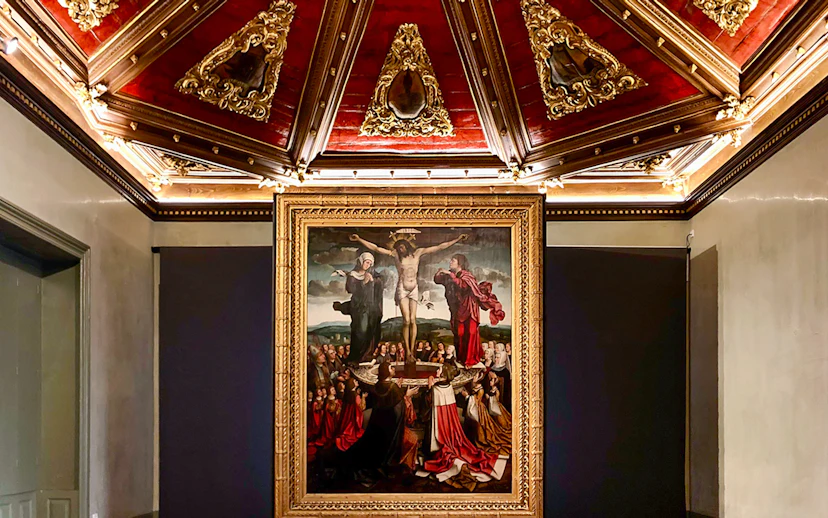
Fons Vitae
Attribute — Artist / Era: Early 16th-century Flemish painting
This is the museum’s signature artwork and the stop that gives the collection a real sense of weight. The scene is dense, symbolic, and easy to underestimate if you only give it a minute, so slow down and look at the details around King Manuel I’s family and the fountain imagery. Many visitors remember the church, but this is the work that lingers after the visit.
Where to find it: On the 1st floor in the dedicated highlight room before you descend to the church
Gallery of Benefactors
Attribute — Era: Mainly 19th-century portrait collection
At first glance this room can feel repetitive, but it is the clearest window into how Porto’s charitable elite shaped the institution. The value here is not one single masterpiece but the scale of patronage the gallery reveals. What most visitors miss is that many of these portraits explain why the museum feels so locally rooted rather than generically religious.
Where to find it: On the top floor at the start of the visit
Sacred art galleries
Attribute — Type: Liturgical silver, vestments, sculpture, and devotional art
These middle galleries are where the museum becomes visually richer after the portrait-heavy opening. If the benefactors’ floor feels dry, this is the section that usually brings people back in with texture, craftsmanship, and stronger visual contrast. The detail most people miss is how much of the institution’s ceremonial life is told through objects rather than wall text.
Where to find it: Across the 2nd-floor galleries between the benefactors’ rooms and Fons Vitae
Sacristy
Attribute — Type: Church treasury and side-room display
Many visitors stop once they have seen the nave, but the sacristy adds a more intimate layer to the church visit. It holds additional objects and gives the ending more depth, especially if you like ecclesiastical interiors and craftsmanship. Because the church itself is the obvious highlight, this side space gets overlooked more often than it should.
Where to find it: Off the church on the ground floor, after you enter the church proper
Facilities and accessibility
- 🎒 Lockers: Free lockers are available at reception for larger bags, umbrellas, and items you should not carry through the galleries.
- 🪑 Seating / rest areas: Seating is available during the visit, which helps if you want to take the museum at a slower pace.
- ♿ Wheelchairs: Wheelchairs are available on request, which is useful because the experience is spread across multiple floors.
- 🍼 Baby-changing facilities: Baby-changing facilities are available on-site, which makes the museum manageable with infants.
- 🎧 Audio guide: Audio-guide support is available and is worth using if you want more context than the wall labels provide.
- ♿ Mobility: The entrance has ramp access, the building has an elevator, the church can be reached with a movable ramp, and the only usual limitation is the high choir area.
- 👁️ Visual impairments: The most practical support is the audio guide, because this is a display-led visit rather than a tactile one.
- 🧠 Cognitive and sensory needs: Weekday mornings are the easiest low-stimulation window, and the museum is generally calm once you move past the entrance from busy Rua das Flores.
- 👨👩👧 Families and strollers: The main route is manageable with strollers thanks to the elevator, and the short overall visit length makes it easier than many larger museums.
This works best for older children who can handle a quiet museum pace, though younger kids may still enjoy the church interior and the shorter overall route.
- 🕐 Time: 45–60 minutes is realistic with children, and the church plus Fons Vitae are the best sections to prioritize.
- 🏠 Facilities: Baby-changing facilities and elevator access make the visit easier than older historic buildings usually are.
- 💡 Engagement: Turn the visit into a visual hunt by asking kids to spot the boldest details in the church tiles, altar, and the crowded Fons Vitae painting.
- 🎒 Logistics: Bring only a small bag, because larger items go into lockers and a lighter visit is much easier on the stairs and around display cases.
- 📍 After your visit: Ribeira is close enough for a riverside walk afterward if children need open air after the quieter museum setting.
Rules and restrictions
Practical tips for your visit
- Booking and arrival: You usually do not need to book far ahead for this museum, but buying ahead can still save a few minutes on weekends or rainy days when more people drift indoors.
- Pacing: Move through the benefactors’ portraits steadily rather than slowly reading every label, and save your attention for the 2nd-floor sacred art, Fons Vitae, and the church.
- Crowd management: Tuesday to Friday mornings are the sweet spot here, because the museum is often at its quietest and the church feels almost private.
- What to bring or leave behind: Bring a small bag and leave bulky gear behind, since large bags and umbrellas go into lockers, and a lighter visit feels much smoother in the galleries.
- Food and drink: Eat before you go if you are visiting near closing time, because there is no real pause-and-return option once you leave the route.
- Context: If institutional history and religious art are not usually your thing, use the audio guide or QR interpretation so the portrait galleries do not feel flatter than they should.
- Photos: Bring a phone or camera that handles low light well, because flash is not allowed, and the church is where most people want their best shots.
- Timing the finale: Leave at least 20 minutes for the church and sacristy, because too many people accidentally spend their time upstairs and then rush the strongest part of the visit.
What else is worth visiting nearby?
Eat, shop and stay near Museu da Misericórdia do Porto
- Cantina 32 (1-minute walk, Rua das Flores 32–34): Portuguese small plates in a convenient same-street location that works well for a relaxed lunch after your visit.
- Mercador Café (1-minute walk, Rua das Flores 36): Coffee, pastries, and light meals that make more sense for a quick pre-visit stop than a full sit-down lunch.
- Puro 4050 (2-minute walk, Rua das Flores 98): Good for specialty coffee and a lighter breakfast if you are doing the museum early in the day.
💡 Pro tip: If you want a quieter meal, visit the museum first and eat after 1pm, when the mid-morning sightseeing crowd on Rua das Flores starts to thin.
- Yes for a short Porto stay, especially if you want to walk almost everywhere. This part of the historic center puts you close to São Bento, Ribeira, the cathedral, and a long list of restaurants, but it is busier and pricier than some other bases. If you are sensitive to street noise, choose carefully.
- Price point: This area leans mid-range to upscale, with the best value usually found a little farther from the busiest streets.
- Best for: Travelers on a short trip who want Porto’s main sights within walking distance and do not want to rely much on transit.
- Consider instead: Baixa works better for a broader city stay, and Vila Nova de Gaia suits travelers who want river views, wine cellars, and a slightly calmer pace.
Frequently asked questions about visiting Museu da Misericórdia do Porto
Most visits take 1–1.5 hours. If you read the displays carefully, use the audio guide, and spend time in the church and sacristy, you could stretch it to nearly 2 hours, but many casual visitors finish in about 45–60 minutes.
No, you usually do not need to book far in advance for this museum. It is generally a low-queue attraction, so most people book ahead for convenience rather than because tickets are likely to sell out.
Arriving 5–10 minutes early is enough if you already have a ticket. If you are buying on-site, give yourself a little extra time and avoid turning up in the final 30 minutes, because last admission is 30 minutes before closing.
Yes, but large bags are not meant to travel through the galleries with you. Bigger backpacks, umbrellas, and bulkier items should be left in the lockers at reception so you can move through the museum more easily.
Yes, personal photography is allowed. Flash is not permitted, and video requires permission, so bring a phone or camera that works well in low light if you want good shots inside the church.
Yes, groups can visit, and the museum also accommodates pre-arranged guided visits. If you are going with a larger group, it is worth planning ahead so entry feels smoother and you can organize interpretation if needed.
Yes, but it suits families best if your children can handle a quiet museum setting for about 45–60 minutes. The route is short, the church is visually striking, and baby-changing facilities help, but this is not a hands-on or play-based attraction.
Yes, most of the route is wheelchair accessible. There is ramped entry, an elevator between floors, a movable ramp into the church, and wheelchairs available on request, though the high choir is not part of the accessible route.
Food is better handled nearby rather than during the visit itself. Rua das Flores and the surrounding streets have plenty of cafés and restaurants within 1–5 minutes, which is the easiest option since re-entry is not allowed once you leave.
You enter the church through the museum, not through the church’s main street-facing door. This catches a lot of visitors out, because the church facade looks like a separate stop but public access normally comes through the museum ticket.
Yes, especially if you are not already interested in Porto’s charitable institutions or religious art. The museum is small, but the context matters here, and the audio guide makes the benefactors’ gallery and major works much easier to understand.
Yes, Porto Card holders can get a reduced admission price on-site. If you have the card, it is usually smarter to buy at the museum rather than pre-book full-price entry online.